
Skip to latest news, August 17, 2026
An interactive map was created by FracTracker in March 2026.
On June 16, 2026, Anne Marie Garti gave a presentation at the Foothills Performing Arts Center in Oneonta, NY on the relationship of gas pipelines to AI data centers, power plants, and other heavy industry. A summary of her power point presentation is here.
On August 18, 2026, the Waterfall Unity Alliance and the Environmental Health Project gave a presentation at SUNY Cobleskill on the impacts of the proposed project. A video of their presentations is here.
On December 19, 2025, Constitution filed a Petition with FERC asking the Commission to:
- re-issue its 2014 order granting Constitution a certificate of public convenience and necessity to build the pipeline; and
- re-affirm its 2019 order declaring that DEC waived its right to deny the 401 water quality certification.
On January 8, 2026, FERC issued a Notice of Constitution’s December 19, 2025 Petition and set January 29, 2026 at 5 pm as the deadline for intervening even though landowners and other interested agencies and municipalities had not yet been formally notified of this proceeding.
FERC must reject or deny this Petition because the two orders Constitution wants FERC to re-issue and re-affirm were vacated by the Second Circuit in 2021. That means the orders are null and void. Since the orders no longer exist, they cannot legally be re-issued or re-affirmed.
In addition, the Second Circuit instructed FERC to “dismiss the agency proceedings[,]” which it has failed to do. On January 13, 2026, New York State Office of the Attorney General (OAG) sent a letter to FERC demanding that the dockets be closed by January 23, 2026, or it would take further action. On January 14, 2026, Stop the Pipeline joined in this request. On January 16, 2026, Earth Justice filed a letter on behalf of a number of environmental groups.
On January 23, 2026, FERC issued an Order on Remand, which described the procedural history and “confirm[ed] that the proceedings referenced in the caption of this order are dismissed.”
On February 23, 2026, the OAG filed a request for rehearing on behalf of the DEC, the Pace Environmental Litigation Clinic (PELC) filed a request for rehearing on behalf of STP, and Earth Justice filed a request for rehearing on behalf of a number of environmental groups. The requests for rehearing say that FERC cannot legally consider the 2025 Petition to reissue the 2014 Certificate Order and reaffirm the 2019 Waiver Order.
In its request for rehearing, STP argues that the Commission must reject the December 19, 2025 Petition filed by the Constitution Pipeline Company in order to comply with the Second Circuit’s 2021 Vacatur Order and FERC’s dismissal of the proceedings.
On March 26, 2026, FERC’s issued an order denying the requests for rehearing (by operation of law), but is still considering its substantive response. This order enables the parties to file a Petition for Review in the appropriate U.S. Court of Appeals within sixty days.
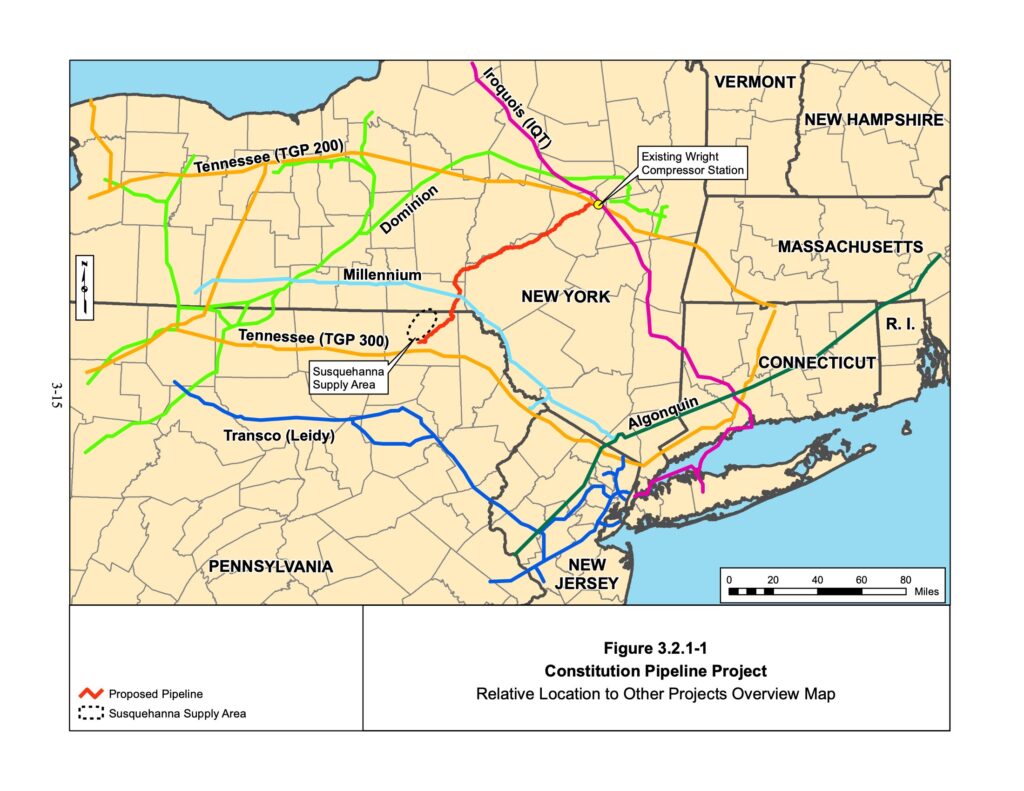
On February 13, 2026, the Iroquois Gas Transmission System, L.P. (“Iroquois”) filed a Petition with FERC purporting to seek an “Expedited Reissuance of Certificate Authority and Approval of Capacity Lease Agreement,” for the Wright Interconnect Project. Iroquois’ petition requests permission to abandon by lease the project’s incremental capacity to Constitution Pipeline Company, LLC. The Commission issued a notice of Iroquois’ petition on February 24, 2026, setting March 17, 2026, as the deadline for intervention. STP intervened and again protested the attempt to evade the Second Circuit’s 2021 Order.
On March 31, 2026, STP sent a letter to FERC exposing errors in the 2025 application that would result in the taking of private property (including land owned by the Kernan Trust) that had been avoided through a reroute in 2015-2016. This is concrete proof that the attempt to reissue the 2014 Certificate Order could lead to the unconstitutional taking of land, as well as other currently unknown mistakes.
On April 3, 2026, FERC issued a Notice of a Scoping Period Requesting Comments on Environmental Issues. Comments are due by 5 pm on May 4, 2026. This gives new landowners, community members, other stakeholders, and regulatory agencies an opportunity to request updated information or suggest entirely new categories for review. People or others who submitted scoping comments in 2012 in docket no. PF12-9 can analyze how FERC reviewed their topic(s) in the Draft or Final Environmental Impact Statement (EIS) and update their scoping comment(s) accordingly.
On May 19, 2026, FERC dismissed the requests for rehearings.
Between May 19th and May 22nd, three petitions for review of FERC’s 2026 orders were filed in the Second Circuit. Earth Justice filed on behalf of a number of environmental groups; the NYS Office of the Attorney General filed on behalf of the DEC; and the Pace Environmental Litigation Clinic filed on behalf of Stop the Pipeline. These petitions will likely be consolidated and put in abeyance until FERC issues an order on whether it will re-issue its 2014 Certificate Order and / or reaffirm its 2019 order declaring that DEC waived its right to deny the 401 water quality certification.
Within the next three weeks, the petitioners in all three cases filed their opening papers, as well as a motion to consolidate the three petitions and put them in abeyance.
Constitution moved to intervene on June 12th and Iroquois moved to intervene on June 16th.
On June 15, 2026, FERC filed a motion to dismiss all three petitions for review, but said in its opposition to consolidation and abeyance that if the court denies its motion to dismiss, the cases should be consolidated and put in abeyance.
On July 27, 2026, the three Petitioners filed briefs in oppposition to FERC’s motion to dismiss. The Pace Environmental Litigation Clinic filed on behalf of Stop the Pipeline. The NYS Office of the Attorney General filed on behalf of the DEC. Earth Justice filed on behalf of a number of environmental groups.
On August 17, 2026, FERC filed its Reply to the three opposition papers.
On August 13, 2026, NYSDEC asked FERC to issue a new EIS, not an EA
On August 21, 2026, FERC issued its Environmental Assessment (EA). Comments are due by 5 pm ET on September 21, 2026. Instructions on how to comment are in its Notice of EA.